supercomputing.com.au AUSTRALIAN COMPUTATIONAL TECHNOLOGY
SUPERCOMPUTING AUSTRALIA

Supercomputing, AI Compute & High Performance Computing in Australia

An Australian technology resource exploring supercomputing, high-performance computing, accelerated AI infrastructure and large-scale computational systems — operated by INTJ Billing Pty Ltd.

539+ Billion cleaned SCATS movements in the applied-HPC case study
3.13+ Billion classified TIRTL vehicle movements
159.6+ Million classified truck movements
Australia Supercomputing, AI compute and digital infrastructure
Australian compute landscape

Computing is becoming infrastructure

High-performance computing is converging with artificial intelligence, GPU acceleration, cloud platforms and high-density data-centre infrastructure. Australia is attracting substantial investment as computation becomes increasingly important to research, industry, economic capability and national infrastructure.

A$10B Data-centre investment attracted by Australia during 2024 according to Australia's National AI Plan.
#2 globally Australia ranked second after the United States for data-centre investment during 2024.
>A$100B Australian data-centre investment plans announced between 2023 and 2025 could scale beyond A$100 billion.
AI at scale AI increasingly depends on compute, accelerated processors, storage, networking, energy and data-centre infrastructure.
Supercomputing explained

What is supercomputing?

Supercomputing is the use of high-performance computational systems to solve problems whose scale, complexity, data volume or required time-to-solution exceeds the practical capability of conventional computers. Modern supercomputing combines large numbers of processors, accelerated computing, high-speed networks, large memory systems and high-throughput storage into an integrated computational environment.

The term high performance computing (HPC) describes the broader engineering and computational discipline used to execute demanding workloads efficiently. A supercomputer is one large-scale implementation of HPC, while HPC techniques can also be applied to clusters, cloud infrastructure, GPU systems and specialised local computing platforms.

Instead of relying primarily on one processor completing instructions sequentially, HPC systems divide work across many CPU cores, GPU accelerators or compute nodes. This parallelism allows simulations, numerical models, artificial-intelligence workloads and large analytical pipelines to process far more computation or data within a useful period of time.

Performance is not determined by processors alone. Real supercomputing workloads depend on the balance between compute, memory bandwidth, interconnect performance, storage throughput, software architecture and workload decomposition.

That same engineering principle applies outside national supercomputers: large analytical workloads can often be made practical through chunking, parallel processing, fast NVMe storage, efficient analytical databases and restart-safe computational workflows.

Parallel computing Large calculations are decomposed so many processors or compute nodes can work concurrently.
CPU and GPU acceleration CPUs provide flexible general-purpose computation while GPUs can accelerate highly parallel numerical, scientific and AI workloads.
High-speed data movement Memory, interconnects and storage must deliver data quickly enough to keep large computational resources productively occupied.
Scalable software Algorithms and workflows must be designed so increasing compute resources actually reduces time-to-solution or increases scale.
National high performance computing

Supercomputing in Australia

Australia's national research computing ecosystem includes two Tier-1 high-performance computing facilities: the National Computational Infrastructure (NCI) and the Pawsey Supercomputing Research Centre. Their flagship systems, Gadi and Setonix, provide large-scale CPU, GPU, data and storage capability for Australian research.

NCI · Canberra

Gadi

Gadi is NCI's flagship supercomputer and supports computationally intensive research across Australian science, government and research institutions. Its architecture combines a very large CPU resource with multiple generations of NVIDIA GPU acceleration and high-performance storage.

4,998 compute nodes listed by NCI
260,000+ CPU cores across multiple processor generations
776 GPUs including accelerator nodes
10+ petaflops peak performance reported by NCI
Official NCI Gadi specifications

Pawsey · Perth

Setonix

Setonix is Pawsey's HPE Cray EX research supercomputer. It combines AMD EPYC CPU nodes with AMD Instinct GPU acceleration and is designed for massively parallel scientific computing, simulation, data-intensive analysis and accelerated workloads.

43 petaflops Rpeak reported by Pawsey
HPE Cray EX supercomputing architecture
AMD EPYC CPUs across large CPU partitions
AMD Instinct GPUs for accelerated computation

Official Pawsey Setonix specifications

What is the difference between HPC and supercomputing?

HPC is the broader practice of using advanced computing techniques and parallel resources for demanding workloads. Supercomputers are the largest and most highly integrated examples of HPC systems.

How are GPUs used in supercomputing?

GPUs contain large numbers of computational units designed for parallel work. They can dramatically accelerate suitable workloads including numerical simulation, machine learning, AI and scientific computing.

How does AI compute relate to HPC?

Modern AI and HPC increasingly share the same underlying infrastructure: large GPU resources, fast networks, high-bandwidth memory, parallel software and very large data pipelines. The workloads differ, but much of the computational engineering converges.

What infrastructure does a supercomputer require?

Large systems require compute processors, high-speed interconnects, memory, parallel storage, workload scheduling, monitoring and substantial power and cooling infrastructure. System balance is as important as raw processor performance.

What is sovereign compute?

Sovereign compute generally refers to computational capability operated within a nation's own legal, security and infrastructure environment. It is increasingly relevant to strategic research, sensitive data, AI and national digital capability.

Who can use Australia's national supercomputers?

Australian researchers can access national HPC resources through institutional arrangements and competitive allocation programs, including the National Computational Merit Allocation Scheme (NCMAS).

Applied supercomputing evidence

Large-scale computation applied to real Australian data

INTJ Billing applies HPC-style data engineering to large Melbourne transport datasets using workload decomposition, staged analytical databases, restart-safe processing and reproducible computation.

SCATS provides long-duration signalised-road traffic information, while TIRTL adds vehicle classification, truck share, direction, speed and freight-corridor intelligence.

The scale and duration of these datasets provide a real-world example of computational engineering beyond ordinary interactive data analysis.

View detailed HPC case study

Computational workflow

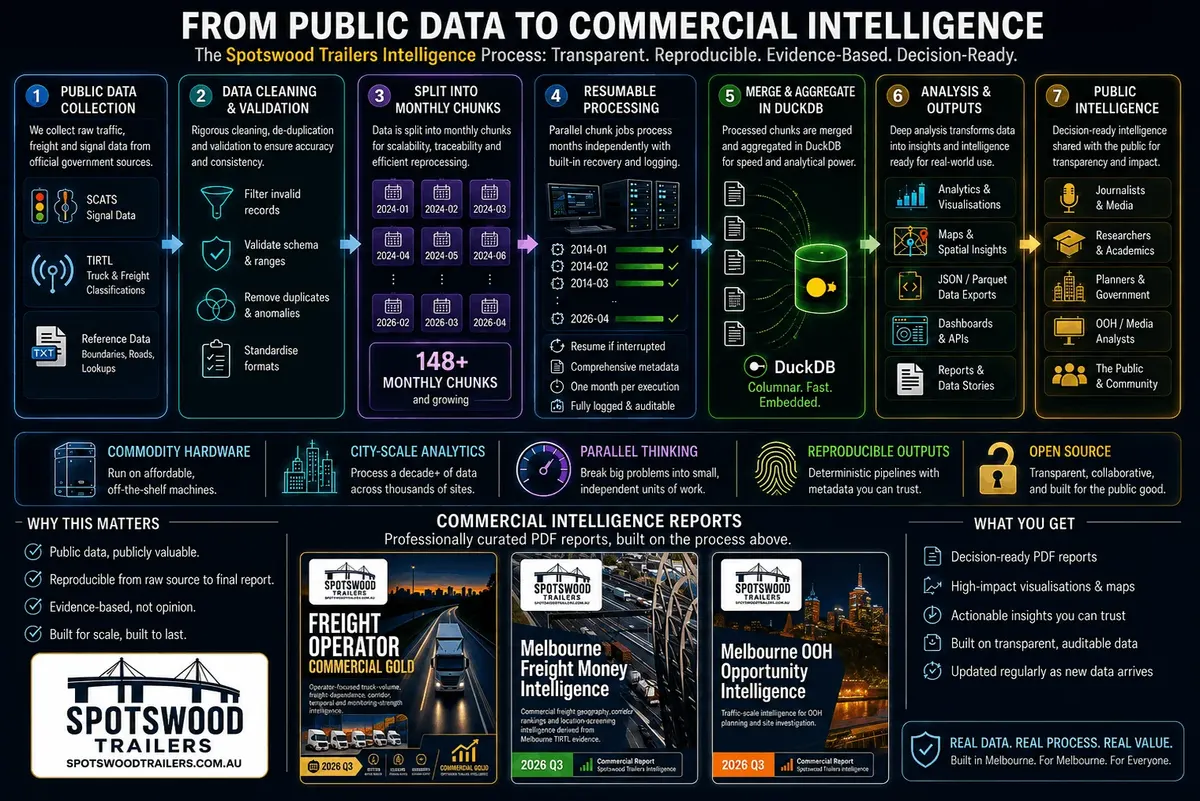
From public data to commercial intelligence

Large datasets are collected, cleaned, validated, partitioned into manageable computational workloads, processed through resumable pipelines, aggregated and transformed into decision-ready outputs.

Computational workflow from public data through cleaning, chunking, resumable processing, aggregation and intelligence outputs.
The modern supercomputing landscape

What supercomputing now encompasses

Supercomputing increasingly spans traditional scientific HPC and the growing computational requirements of artificial intelligence, accelerated computing, large-scale analytics and digital infrastructure.

AI & GPU Computing

Accelerated training, inference and highly parallel computational workloads.

Scientific Computing

Simulation, modelling, computational science and numerical research workloads.

Data-Centre Infrastructure

High-density compute, power, cooling, networking and storage infrastructure.

Large-Scale Analytics

Computational workflows for datasets beyond ordinary interactive processing.

HPC Engineering

Linux, storage, automation, workload performance and systems engineering.

Sovereign Compute

Domestic capability supporting strategically important Australian computation.

Australian digital infrastructure asset

About supercomputing.com.au

supercomputing.com.au is actively used in connection with high-performance computing, large-scale analytical processing and computational technology.

It is being developed as a long-term Australian digital asset around the increasingly important intersection of supercomputing, artificial intelligence and compute infrastructure.

supercomputing.com.au
Current registrant and operator: INTJ Billing Pty Ltd

INTJ Billing is an Australian technology company established in 2016. Its applied computing activities include large-scale transport analytics, data engineering, Linux infrastructure and computational workflows demonstrated through the SCATS and TIRTL intelligence platforms.

The domain provides a concise Australian identity around a technology category whose relevance increasingly extends from scientific supercomputing into AI compute, GPU infrastructure, cloud platforms and high-density data centres.

Domain supercomputing.com.au
Registrant / operator INTJ Billing Pty Ltd
Australian company ABN 30 607 261 398
Current use Applied HPC, computational technology and large-scale analytics
Related evidence Melbourne SCATS & TIRTL computational intelligence
Strategic acquisition enquiries

Available to the right strategic buyer

supercomputing.com.au is an active Australian technology asset rather than a passive parked domain. INTJ Billing Pty Ltd intends to continue developing it, but is prepared to consider a substantial proposal from an organisation for which the domain has genuine strategic value.

Serious approaches are welcomed from organisations involved in supercomputing, high-performance computing, artificial intelligence, GPU infrastructure, cloud computing, scientific computing, sovereign compute, Australian data centres and related digital infrastructure.

https:// supercomputing.com.au
Australian computational technology
supercomputing.com.au
Strategic Australian compute domain
Companion domain: highperformancecomputing.com.au
Confidential commercial discussion

Discuss supercomputing.com.au

There is no fixed public asking price. Proposals are considered according to the prospective acquirer, intended use, strategic fit and overall commercial value.

Prospective buyers are encouraged to identify their organisation, intended use and proposal clearly. Strategic partnerships and other commercial structures may also be considered where there is a compelling long-term fit.

Optional, but an indicative range can help establish whether there is a basis for further discussion.
If an NDA or confidential discussion is required before detailed information is exchanged, mention that here.
Any transfer of a .com.au domain-name licence remains subject to applicable .au Domain Administration eligibility, allocation and registrant-transfer requirements. auDA transfer information . Submission of this form does not constitute an agreement to sell or transfer the domain.